 Quality Services,
TPO gets most of the attention in commercial roofing conversations today, but EPDM roofing remains one of the most proven flat roofing systems available for commercial buildings in Indianapolis, IN. It has been installed on commercial roofs for over five decades, and the buildings where it still has a strong case are more common than most building owners realize.
At CVC Roofing, we install EPDM systems on commercial buildings across Indianapolis, and we match the membrane to the building rather than defaulting to one system for every project. Call us at (317) 557-0888 to find out whether EPDM is the right call for your building.
This article covers where EPDM still makes sense for Indianapolis commercial buildings in today’s market, how it compares to TPO in practical terms, and what the specific building types and ownership scenarios are where EPDM is the stronger specification.
EPDM Roofing: Is It Right for You?
EPDM is a synthetic rubber membrane that has been installed on commercial flat roofs since the 1960s, and that longevity is not accidental. Well-installed EPDM systems on commercial buildings have demonstrated service lives of 25 years or more, and the material’s inherent flexibility makes it tolerant of the thermal movement that Indianapolis buildings experience across the state’s wide seasonal temperature range.
Where EPDM makes the most sense today is in applications where long-term durability and a lower upfront investment are the primary considerations, where the building does not have a heavy rooftop equipment load that benefits from a thicker membrane, and where reflectivity is not a priority because the building’s cooling load is managed through other means. Industrial buildings, warehouses, and lower-occupancy commercial properties where the roof is largely out of sight and out of mind are applications where EPDM continues to deliver reliable performance without the premium specification cost of other systems.
How EPDM Compares to TPO
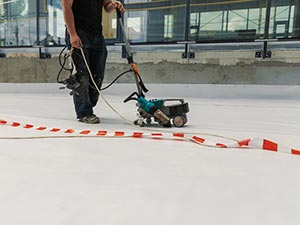
The practical differences between EPDM and TPO on an Indianapolis commercial roof come down to a few key variables. TPO’s white reflective surface reduces rooftop temperatures significantly during Indiana’s hot summers, cutting cooling loads on buildings that run HVAC systems heavily from May through September. EPDM’s black surface absorbs heat, which increases cooling demand in summer but can reduce heating demand in winter, a trade-off that matters more in northern climates than it does in Indianapolis. TPO seams are heat-welded, creating a fusion bond that is structurally strong when done correctly. EPDM seams are adhesive-bonded, which requires proper surface preparation and compatible products to hold reliably over time. Neither system is categorically better than the other. The right choice depends on the building’s use, the owner’s performance priorities, and the application conditions the roof will face.
EPDM Membrane Options
EPDM membranes are available in 45-mil and 60-mil thicknesses, and in both standard black and white-coated versions for applications where reflectivity matters. Wider sheet widths reduce the number of seams on a given roof, which directly reduces the number of potential failure points across the membrane field. Fully adhered EPDM, where the membrane is bonded to the insulation substrate across its full surface area, performs better under wind uplift than mechanically fastened or ballasted systems, and is the preferred attachment method on most occupied commercial buildings in Indiana where roof ballast would add significant structural load. The thickness, width, and attachment method selections should all be driven by the building’s specific demands rather than defaulted to the lowest-cost combination the contractor can source.
EPDM Installation
EPDM installation quality comes down to seam preparation and execution. The membrane surface at every lap must be properly cleaned and primed before bonding adhesive is applied. Adhesives must be applied to both surfaces and allowed to reach proper tack before the seam is rolled and pressed. Seam tape at the lap perimeter completes the bond.
Temperature during application must fall within the adhesive manufacturer’s specified range, and Indianapolis contractors know that spring and fall installations in marginal temperature conditions require additional care. A seam that was bonded in too-cold conditions or without proper surface preparation looks finished for a season and separates the first time Indiana heat expands the membrane and puts tension on the lap. The failure is in the installation, not the material, and it is entirely preventable when the process is followed correctly.
Find Out If EPDM Roofing Is Right for Your Indianapolis, IN Building
EPDM roofing in Indianapolis, Indiana still makes strong sense for the right commercial buildings, and the decision deserves a real conversation rather than a default to whatever membrane is most popular right now. At CVC Roofing, we assess Indianapolis commercial buildings and recommend the system that fits, whether that is EPDM, TPO, or something else entirely. Call us at (317) 557-0888 and let us give your building an honest assessment.
FAQ
How long does EPDM roofing typically last on a commercial building in Indianapolis?
Well-installed EPDM systems on commercial buildings commonly achieve 20 to 25 years of service life with proper maintenance and prompt attention to seam and flashing repairs.
Can EPDM be installed over an existing roof on an Indianapolis commercial building?
A recovery is possible over a single dry existing membrane when code permits and the deck can handle the additional load, though wet insulation must be identified and replaced first.
Is white EPDM a practical option for Indianapolis commercial buildings concerned about cooling costs?
White-coated EPDM is available and improves surface reflectivity, though its reflectance performance falls below that of white TPO or PVC membranes.
What is the typical warranty term for a commercial EPDM installation in Indiana?
Manufacturer warranties on commercial EPDM systems typically range from 10 to 20 years depending on the membrane manufacturer, thickness, and the contractor’s certification level.