 Quality Services,
For Anderson’s manufacturing and warehouse owners, the roof over a large conditioned space is a real factor in what the building costs to run. The right commercial roofing contractor can turn that roof into an asset that lowers cooling bills year after year.
CVC Roofing & Sheet Metal builds energy performance into the work. Call CVC Roofing & Sheet Metal at (317) 557-0888 for a commercial roofing contractor in Anderson, IN.
Your Commercial Roofing Contractor Shapes Energy Costs
The roof does more for a building’s energy use than most owners give it credit for. Solar reflectance, thermal emittance, and the insulation’s R-value together decide how much summer heat pushes through the assembly into the space below.
Those are not accidents of the roof; they are choices. A contractor who understands them specifies a system that keeps heat out, and one who does not leaves easy savings on the table across Indiana’s long cooling season.
Roofing Systems That Cut Cooling Loads
White and light-colored single-ply membranes reflect much of the sun before it becomes heat, and reflective coatings can add that same quality to a sound existing roof without a full replacement. Both lower the surface temperature the building has to fight.
Reflectance is only half of it. A surface can bounce sunlight and still re-radiate the heat it absorbs, so good systems pair high reflectance with strong thermal emittance. Underneath, continuous insulation without gaps at fasteners or seams carries the R-value the assembly is rated for.
Why a Commercial Roofing Contractor Decides the Payoff
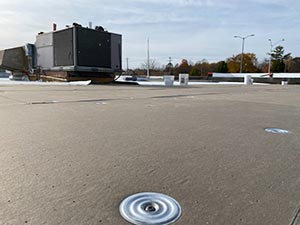
An efficient system only performs when it is installed right. Gaps in the insulation, fastening patterns that bridge heat, and weak seams all let a roof fall short of its rated numbers, sometimes by a wide margin.
That is where the contractor matters most. The difference between a properly installed and a poorly installed energy-efficient roof is measured in the utility bill every month, so experience with these systems is what turns the specification into real savings.
Timing an Energy Upgrade with Your Commercial Roofing Contractor
The return on an energy-efficient roof depends partly on timing. When a roof is already near the end of its life, folding a reflective system and better insulation into the replacement captures the energy benefit without paying twice, since the work is happening anyway. Planning the upgrade around the roof’s natural replacement point is what shortens the payback.
The savings then compound across Indiana’s long cooling season. A reflective roof that keeps a large conditioned space cooler works every sunny day, and on a manufacturing or warehouse footprint those reduced cooling loads add up year after year. Some efficient systems may also qualify for utility incentives, which improves the math further.
The roof is easy to overlook when it is not leaking, yet it quietly shapes the utility bill every month. Treating it as part of the building’s energy strategy, rather than just a cover overhead, is what turns that hidden cost into a lasting saving.
Choosing an Anderson Commercial Roofing Contractor
A commercial roofing contractor who understands reflective systems, insulation, and careful installation delivers a roof that costs less to operate for its whole life. For a large building in Indiana, that expertise is what makes the energy benefit real rather than theoretical.
For a building owner watching operating costs, the roof is one of the few upgrades that keeps paying back every summer, and the right contractor is what makes sure that benefit is actually delivered.
For a commercial roofing contractor in Anderson, IN, contact CVC Roofing & Sheet Metal at (317) 557-0888 today.
FAQ
Can a new commercial roof lower my energy bills?
Yes. A reflective membrane over adequate insulation reduces the heat entering the building, which eases the cooling load during central Indiana summers.
Which roofing systems are most energy-efficient?
White single-ply membranes and reflective coatings over sound roofs perform well, but only when the insulation beneath is continuous and correctly installed.
Does the contractor really affect energy performance?
It does. Gaps in insulation, poor fastening, and weak seams let an efficient system underperform its ratings, so installation skill decides the real result.