 Quality Services,
Indianapolis buildings see rain in every form, from spring downpours to winter melt. Proper gutter installation is what channels all that water off the roof and away from the structure.
Call CVC Roofing & Sheet Metal at (317) 557-0888 for gutter installation in Indianapolis, IN.
Indianapolis Rain Demands Quality Gutter Installation
Central Indiana sees steady rainfall across the year, and a commercial roof sheds a lot of it fast. Without a gutter system sized for that volume, water sheets off the edge, pools at the foundation, and works into the walls. On an Indianapolis warehouse or plant, a roof that big turns even an ordinary storm into serious runoff. Downspouts and outlets have to be planned for that peak, not added as an afterthought.
On a large flat or low-slope roof, the volume during a hard rain is more than most owners picture. Good gutter installation is built around how much water the roof actually moves, not a rough guess, and that begins with sizing the system to the building.
Sizing a Gutter Installation for Seasonal Volume
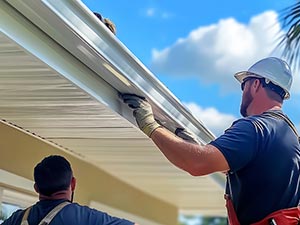
Spring storms drop water in short, heavy bursts, and the system has to carry that peak without overflowing. That means matching gutter width and downspout count to the roof’s square footage and slope. Getting the outlets right is half of getting the capacity right. A distribution roof with a long, low slope concentrates water toward just a few outlets. Slope and outlet count work together to clear water before it backs up.
An undersized system looks fine until the first hard rain proves otherwise, and overflow during those peaks is the clearest sign it was never sized correctly. Capacity is the heart of the job. Where the water goes after that matters just as much.
Drainage That Moves Water Clear of the Building
Gutters only help if the downspouts carry water well away from the foundation. On a commercial building, that often means tying into a drainage plan that handles runoff at scale. Water dumped at the base of the wall undoes the whole point of the system. Around loading docks and truck courts, standing water is more than a nuisance; it is a hazard. Getting the discharge right protects landscaping and pavement as much as the wall.
A short extension or tie-in keeps that runoff from circling back, and a little planning at the discharge saves the foundation years of stress. With the water routed clear, one more Indiana problem is left to solve, which is what winter does to it.
Indiana Winters Test the Gutter Installation
Melting snow refreezes in gutters and at the roof edge, and a loosely hung or poorly pitched system sags or pulls away under that weight. Correct slope, solid hangers, and proper spacing keep the run intact through the cold months. A commercial building that runs through Indiana winters cannot afford a system that ices up and pulls loose. A properly pitched system also sheds meltwater before it can refreeze.
Ice is heavy, and a system that was not hung for it shows the strain fast. A gutter installation built for Indiana weather holds up when the seasons turn, and that reliability is exactly what a commercial building needs at the roof edge.
Get Gutter Installation Built for Indianapolis
Water is relentless in central Indiana, and a well-built gutter system keeps it under control. Sound gutter installation protects the roof edge, the walls, and the foundation beneath them. For gutter installation in Indianapolis, IN, contact CVC Roofing & Sheet Metal at (317) 557-0888 today.
FAQ
How do I know if my commercial gutters are big enough?
If they overflow during heavy rain, they are undersized. Capacity should match the roof’s square footage, slope, and the region’s peak rainfall.
How long does commercial gutter installation take?
It depends on building size and system complexity, but many commercial jobs finish within a few days once the design is set.
Why does downspout placement matter so much?
Downspouts carry collected water away from the foundation. Too few or poorly placed ones let water pool where it can damage the structure.