 Quality Services,
For commercial property owners in Kokomo, IN, a roof inspection is most useful when it produces clear evidence for the next decision. The report should show what was found, where it was found, what remains uncertain, and whether the next step is maintenance, a localized repair, further investigation, restoration, or replacement planning. Contact CVC Roofing & Sheet Metal at (317) 557-0888 to discuss a commercial roof inspection.
What a Commercial Roof Inspection Report Should Include
A useful inspection report should be specific enough for an owner or facility manager to act on later. General phrases such as “roof needs attention” do not identify where the problem is, how urgent it is, or what evidence supports the recommendation.
| Report Item | What Should Be Documented | Why It Matters |
|---|---|---|
| Dated photos | Overall roof views plus close-ups of defects, with the inspection date retained in the report or photo record | Creates a condition baseline that can be compared with future visits. |
| Defect locations | Roof section, drain, curb, wall, penetration, edge, or other reference that allows the area to be found again | Lets repair crews price and revisit the correct location. |
| Moisture limitations | What was screened, which method was used, what could not be verified, and whether a finding still needs confirmation | Separates observed evidence from suspected concealed conditions. |
| Priority | Whether an item needs prompt repair, planned follow-up, monitoring, or broader assessment | Helps owners direct budget and attention to the most important work first. |
| Reinspection trigger | The condition that should prompt another review, such as recurring leakage, new damage, severe weather, or change at a monitored defect | Gives the owner a reason to revisit the roof instead of relying on a vague calendar reminder. |
Thermal and Moisture Findings Need Confirmation
Infrared or other moisture-screening methods can help identify areas that deserve closer investigation, but a thermal anomaly is not automatic proof of saturated insulation. Roof construction, surface temperature, recent weather, insulation type, and the timing of the scan can affect what appears on the image.
If a suspected wet area would materially change the repair or replacement scope, the report should explain what additional confirmation is appropriate before treating that finding as established damage. The confirmation method depends on the roof assembly and the condition being investigated, so one test should not be presented as universal for every roof.
How the Report Becomes a Scoped Estimate
The completed report should go to the property owner, facility manager, or other person responsible for the building. It may also be shared with an insurer, lender, consultant, or other party when documentation is requested, but the report should remain clear about what was observed and what still needs confirmation.
When pricing is prepared, each repair item should connect back to a documented condition and location. A scoped estimate should identify what is being repaired, where the work is located, the proposed method, assumptions, exclusions, and what could expand the scope after work begins.
Identifying Risks Before They Affect Operations
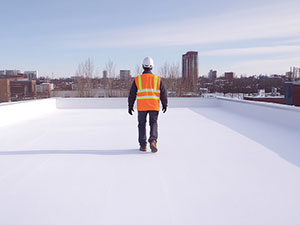
Open seams, damaged flashing, punctures, blocked drainage, failed sealants, and other visible defects may be repairable when they are found early. The inspection should also note whether a condition is isolated or repeated across several roof sections because that distinction can change the recommended scope.
An interior stain alone should not be used to diagnose the roof. Water can travel within the roofing assembly before appearing inside, so the entry point and moisture extent need roof-level evidence.
Using Inspection Findings for Maintenance and Capital Planning
Inspection findings can be grouped into work that needs prompt attention, work that can be scheduled, and conditions that should be monitored. That helps the owner distinguish ordinary maintenance from a repair project or a broader assessment.
If the evidence shows repeated failures, widespread deterioration, recurring moisture, or other conditions that make localized repair unreliable, the inspection can support a replacement discussion. CVC Roofing’s flat roof replacement guidance provides a related example of the factors owners consider when replacement becomes the more appropriate scope.
Inspection Records Should Support Future Decisions
A documented inspection creates a baseline that can be compared with later visits. If a seam opens again, flashing continues to move, ponding repeats, or another leak appears in the same section, the owner can see that pattern instead of treating each event as unrelated.
Good records can also support warranty or insurance documentation when relevant, but they do not guarantee coverage. The applicable warranty documents, policy terms, reported event, maintenance history, and other facts still control those decisions.
Commercial Roof Inspection in Kokomo, IN
For Kokomo property owners, the goal of an inspection is not simply to generate a list of defects. It is to provide enough evidence to choose the next practical step and enough detail for that work to be scoped clearly.
CVC Roofing & Sheet Metal provides commercial roofing services in Indiana. Its commercial roofing contractor guidance also emphasizes inspection, repair, maintenance, and replacement as connected decisions rather than isolated services.
Call (317) 557-0888 to discuss a commercial roof inspection in Kokomo, IN.
Frequently Asked Questions
What should I receive after a commercial roof inspection?
A useful report should include dated photos, exact defect locations, diagnostic limitations, priorities, and clear follow-up or reinspection triggers.
Do thermal findings prove that insulation is wet?
No. Thermal findings can identify areas that deserve closer investigation, but important findings may need confirmation before they define a repair or replacement scope.
How does an inspection report help with a repair estimate?
It gives the contractor documented conditions and locations to price, making the estimate more specific and easier for the owner to evaluate.
Can an inspection determine whether I need repair or replacement?
It can provide the evidence needed for that decision, but the recommendation should follow the extent of damage, moisture, repeated failures, drainage, and the condition of the roofing assembly.