 Quality Services,
Spring storms in Indiana can expose or worsen problems on commercial flat roofs, including seam separation, punctures, flashing damage, and water intrusion. For a building owner in Anderson, IN, the useful question is not simply whether the roof was hit by hail or wind. It is whether the inspection evidence supports a contained repair or shows that a broader roof assessment is needed.
CVC Roofing & Sheet Metal provides commercial roof repair for properties in Anderson, IN. Call 317-557-0888 to discuss a post-storm assessment and the conditions you have observed from safe, accessible areas.
What the Evidence on Your Roof Tells You After a Storm
An interior stain, lifted edge, or soft area is useful evidence, but none of those observations establishes the full repair scope by itself. The contractor should connect the visible condition with surrounding seams, flashing, penetrations, drainage, and any moisture findings before deciding that the damage is localized.
| Observed Area | Evidence Needed Before Setting Scope | What the Finding May Support |
|---|---|---|
| Seams | Confirm how much seam is open or stressed, whether similar conditions appear nearby, and whether the surrounding membrane remains suitable for repair. | A targeted seam repair when the condition is contained, or a broader assessment when seam problems repeat across several roof areas. |
| Penetrations | Inspect the full curb, vent, pipe, or equipment detail plus the adjacent membrane and flashing instead of repairing only the most visible opening. | A focused penetration repair when nearby materials remain serviceable. |
| Edge and parapet flashing | Check the affected section, fasteners, terminations, adjoining membrane, and nearby edge conditions for movement or separation. | Localized flashing work when the problem is limited, or a wider perimeter review when similar movement appears in multiple sections. |
| Moisture extent | Determine whether moisture appears isolated or extends beyond the visible defect. If screening methods suggest a larger area, confirm the condition with an appropriate follow-up method before setting major repair scope. | A contained repair when affected material is limited, or a broader roof assessment when moisture or deterioration extends farther than expected. |
CVC’s flat roof repair guidance provides additional context on seams, flashing, ponding, and membrane conditions that can influence repair scope.
Commercial Roof Repair After an Indiana Storm
Storm damage does not follow one universal pattern. Hail and wind can affect membranes, edges, flashing, or rooftop details, while existing wear may also become more noticeable after a storm. The inspection should document what is actually damaged and whether the surrounding roof remains serviceable.
What Hail Can Affect
Hail can affect membranes, metal components, rooftop equipment, or insulation depending on the roof and the event. A visual review can identify obvious damage, but suspected concealed moisture or insulation problems need separate evidence.
On TPO, PVC, EPDM, and other single-ply roofing systems, the repair method must also match the membrane. A contractor should identify the roof material and verify compatible repair materials instead of applying one generic storm patch to every system.
Where Wind Damage May Appear
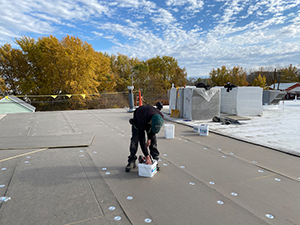
Edges, parapet details, membrane terminations, rooftop equipment, and penetration flashings can all be exposed to wind. If one flashing detail has moved, nearby components should be checked before the work is treated as isolated.
Interior water can also travel before it becomes visible. A ceiling stain therefore helps direct the investigation but does not prove that the entry point is directly above it or that the affected area is limited to one location.
When Seams Need a Broader Review
One open or damaged seam may support a localized repair when nearby seams remain sound. Several similar seam failures across different roof areas can point to a broader condition involving age, installation quality, movement, or repeated weather exposure. The repair recommendation should state which condition was actually observed rather than assume one cause from appearance alone.
What a Post-Storm Repair Quote Should Include
A useful quote should identify the repair area, documented defect, proposed materials or method, preparation, flashing or penetration work, cleanup, exclusions, and conditions that could change the scope. Photos and location references can connect the price to the inspection findings.
The quote should also explain how unexpected wet insulation, damaged substrate, or additional defects will be documented and approved if discovered during the work. If the inspection shows widespread deterioration or moisture, the owner may need to compare the repair with a broader commercial roof replacement assessment in Anderson rather than authorize repeated isolated patches.
Plan Roof Access Around Building Operations
Building staff can provide access information, security requirements, tenant schedules, and known interior leak locations. The contractor should determine the safe roof-access route, staging, fall protection, and coordination around occupied areas. Owners and facility staff should not climb onto a storm-affected roof to investigate damage themselves.
Thorough Commercial Roof Repair
A localized commercial roof repair makes sense when the defect can be defined and the surrounding roof remains suitable for repair. When seams fail in several areas, flashing movement repeats around the perimeter, or moisture extends beyond the visible defect, further assessment should come before another patch.
For commercial roof repair in Anderson, IN, call CVC Roofing & Sheet Metal at 317-557-0888.
Frequently Asked Questions
Can a ceiling stain show exactly where a commercial roof is leaking?
No. Water can travel through the roof assembly before it becomes visible inside, so the entry point and moisture extent need inspection before the repair scope is defined.
Can hail damage a commercial roof without creating an obvious hole?
Yes. Some damage can be subtle, but the contractor should document the actual condition and use appropriate testing when concealed moisture or insulation damage is suspected.
When is a localized storm repair reasonable?
It is most reasonable when the defect is contained and surrounding seams, flashing, membrane, insulation, and substrate remain suitable for repair.
Should building staff climb onto the roof after a storm?
No. Staff can report interior symptoms and access information, while roof-level inspection should follow the contractor’s safety and access plan.