 Quality Services,
The decisions made during new construction roofing shape how a commercial building performs and what it is worth for the next 30 years. Most building owners focus on the upfront cost. The owners who get more value out of their buildings focus on the specification. At CVC Roofing, we work with commercial developers and property owners across Indiana on new construction projects designed to perform well from day one and hold their value over time. Call us at 317-557-0888 to discuss your project.
Anderson, IN and the surrounding Madison County area has seen steady commercial development, with industrial, warehouse, and mixed-use properties going up alongside the region’s manufacturing base. Every one of those buildings starts with a roofing decision that either supports or undermines its long-term value. Getting that decision right at construction is far easier than correcting it later.
New Construction Roofing Decisions That Pay Off
The specification stage is where long-term value is won or lost on a commercial roof. Membrane type, insulation thickness, drainage design, and warranty tier all get decided before a single fastener goes into the deck. Each choice has consequences that compound over the life of the building.
A building owner who chooses the minimum-spec roof to save money at construction will face that decision again in 12 to 15 years when the system fails early and the warranty has run out. A properly specified roof can perform for 25 to 30 years with routine maintenance and deliver energy savings throughout. That gap in performance translates directly into property value.
Why Insulation Specification in New Construction Roofing Matters Most
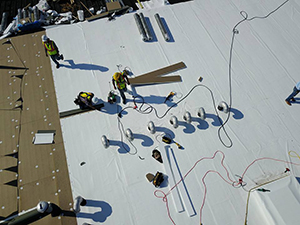
Insulation is the new construction roofing decision that cannot be corrected cheaply later. Once the membrane is down and the building is occupied, upgrading insulation means tearing the roof off and starting over. Whatever R-value goes in at construction is largely what the building gets for the life of that roof.
Indiana’s commercial energy codes require specific minimum R-values for low-slope commercial roof assemblies and meeting that minimum is not the same as optimizing for performance. Buildings in Anderson running HVAC year-round through Indiana’s hot summers and cold winters benefit from insulation specified above the code minimum. Energy savings over 20 years roof life are significant, and better energy performance is one of the first things commercial buyers and appraisers look at when evaluating a building.
Membrane Choice and What New Construction Roofing Gets Right
Not every membrane performs equally well on every building type. The right membrane for a new construction project depends on roof geometry, intended use, rooftop equipment load, and the building’s drainage design. Specifying the wrong membrane at construction creates performance problems that surface within the first few years and cannot be resolved without replacement.
For Indiana commercial buildings, single-ply membranes like TPO and PVC handle the state’s temperature swings well and deliver reliable performance when properly installed and welded. The installation quality matters as much as the product. A premium membrane installed by an uncertified contractor with poor weld technique performs worse than a mid-grade membrane installed correctly. New construction is the one opportunity to get both right simultaneously.
How New Construction Roof Warranty Tier Affects Property Value
The warranty selected for new construction follows the building. A No Dollar Limit warranty from a reputable manufacturer is a transferable asset that commercial buyers take seriously. It signals that the roof was installed by a certified contractor, meets manufacturer standards, and carries coverage that transfers to the new owner. That is a meaningful differentiator when a building goes to market.
Here is what the warranty tier decision at new construction actually covers:
- Material-only warranties cover membrane defects but leave the building owner paying for all labor on any repair, even manufacturer-caused failures.
- Labor and material warranties cover both, removing the cost exposure that comes with a materials-only policy on a large commercial roof.
- NDL (No Dollar Limit) warranties remove the repair cost cap entirely and are the strongest protection available for a commercial building owner.
New Construction Roofing That Holds Its Value
New construction roofing done right protects the building’s value from the first day of occupancy through every ownership cycle after that. At CVC Roofing, we work with commercial developers and property owners across Anderson, IN to specify and install roofing systems built for long-term performance. Call us at 317-557-0888 to talk through what your new construction project needs.
FAQ
What roofing system is best for new commercial construction in Indiana?
Single-ply systems like TPO and PVC are the most common choice for Indiana commercial new construction due to their performance in temperature extremes and ease of installation on low-slope roofs.
Does new construction roofing come with a manufacturer warranty?
Yes, but only when installed by a certified contractor meeting the manufacturer’s application standards. Always confirm certification before the project begins.
How does roofing insulation affect commercial property value?
Higher R-value insulation reduces energy costs year-round, which improves net operating income and directly supports a higher property valuation.
Can a commercial roofing warranty transfer to a new owner?
Most manufacturer warranties are transferable if registered within the required timeframe after sale. NDL warranties are particularly valuable at resale for this reason.