 Quality Services,
Most commercial roof failures do not happen without warning. They develop over months, sometimes years, through problems that commercial roof maintenance is specifically designed to catch and stop. At CVC Roofing, we inspect and maintain commercial roofs across Anderson, IN, and the same failure patterns show up on buildings where maintenance was skipped. Call us at 317-557-0888 to get a maintenance visit scheduled before a small problem becomes a big one.
Anderson commercial buildings deal with a full range of Indiana weather: heavy spring rains, hot and humid summers, and freeze-thaw cycles that run from November through March. Each season puts specific stress on different parts of a roof. A maintenance program built around that cycle catches problems at the right time instead of after the damage is done.
Common Roof Failures Commercial Roof Maintenance Prevents
The failures we see most often on unmaintained commercial roofs in Indiana are not random. They follow predictable patterns, and every one of them has a maintenance step that would have caught it earlier. Understanding how each failure develops helps building owners see why the maintenance schedule matters.
Seam separation, flashing failure, drain blockage, and membrane surface degradation are the four failure types we find repeatedly on commercial buildings that have gone two or more years without a professional inspection. Each one starts small, progresses quietly, and becomes expensive once it reaches the point where water has entered the assembly.
How Commercial Roof Maintenance Stops Drain Failures
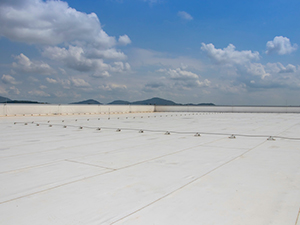
Blocked drains are the leading cause of premature membrane failure on low-slope commercial roofs in Indiana, and they are entirely preventable. When a drain or scupper is blocked by debris, water ponds on the roof surface after each rain event. Indiana’s spring storm season can deliver multiple heavy rain events in a single week.
Ponding water that sits on a membrane for more than 48 hours does real damage. It adds structural load, forces its way through any weak point in the membrane or seams, and accelerates surface deterioration at the contact area. Building owners often blame the membrane when the actual problem starts at a clogged drain. A maintenance visit clears every drain and scupper and checks that water is moving off the roof the way it should.
Flashing Failures That Commercial Roof Maintenance Catches Early
Flashings fail before the membrane does on most commercial roofs. The flashing detail at walls, curbs, and penetrations is where the flat membrane meets a vertical surface, and that transition point takes more thermal movement stress than anywhere else on the roof. Over time, the flashing adhesive softens and releases, or the termination bar lifts away from the wall.
Once a flashing separates, water has a direct entry point into the wall assembly or insulation layer below. The membrane itself may be perfectly intact. A maintenance inspection checks every flashing termination by hand, probing for any lift or soft spot. Catching a flashing that has started to release costs a fraction of what it costs to address the water damage after it has been leaking through a wall for a season.
Seam Separation and Why Maintenance Finds It First
Seam separation is the failure type that catches building owners most off guard because it is invisible from the roof surface until it is well advanced. The seam between two membrane sheets can begin releasing at the adhesive bond while the surface above still looks fine. By the time a seam failure is visible, water has usually been entering the insulation layer for weeks.
During a commercial roof maintenance visit, every seam gets probed along its full length. Any area that gives or feels soft gets addressed immediately with lap sealant or seam tape before the next rain. This is work that takes minutes per linear foot during a scheduled visit. The same repair after a leak has developed means pulling wet insulation and dealing with deck damage underneath.
Commercial Roof Maintenance Protects Anderson Facilities
Every failure type above is preventable. The maintenance steps are not complicated, but they have to happen on a schedule. At CVC Roofing, we provide commercial roof maintenance programs for buildings across Anderson, IN that are built around Indiana’s seasonal demands. Call us at 317-557-0888 to set up a maintenance program or schedule a single inspection to see where your roof stands.
FAQ
How often does a commercial roof need maintenance in Indiana?
Twice a year is the standard: spring after freeze-thaw season and fall before temperatures drop below freezing.
Can skipping commercial roof maintenance void my warranty?
Yes. Most manufacturer warranties require documented annual inspections by a certified contractor to remain valid.
What does a commercial roof maintenance visit actually include?
A thorough visit covers drain clearing, seam probing, flashing inspection, surface condition assessment, and written documentation of any areas needing repair.
How do I know if my commercial roof has ponding water damage?
Soft or discolored areas near drains, blistering on the membrane surface, and interior ceiling stains near the roof center are common indicators.