 Quality Services,
PVC single-ply roofing can be a strong option for commercial low-slope buildings in Greenwood, IN, but the membrane should be selected for the actual roof assembly rather than for broad claims about durability, reflectivity, or chemical resistance. Substrate condition, drainage, attachment, insulation, rooftop activity, detailing, and future service access all affect whether PVC is a good fit.
CVC Roofing & Sheet Metal provides commercial single-ply roofing in Indiana, including PVC systems. For a Greenwood facility, the useful first step is to confirm the existing roof conditions and the proposed assembly before choosing the membrane. Call 317-557-0888 to discuss a commercial roof evaluation.
Is PVC the Right Fit for Your Building?
PVC, or polyvinyl chloride, is a thermoplastic single-ply membrane with hot-air-welded seams. Light-colored PVC can provide a reflective roof surface, and some PVC formulations are selected where grease, oils, or certain chemical exposures matter. Those characteristics can be useful, but they do not make PVC the right choice for every commercial building.
| Factor | What to Confirm | Why It Matters for PVC |
|---|---|---|
| Substrate condition | Deck soundness, moisture, deterioration, and preparation needs | PVC should be installed over a suitable prepared assembly. Wet, damaged, or unstable materials may require repair or removal first. |
| Drainage | Slope, drains, scuppers, and areas where water remains after rain | Membrane selection does not correct a drainage design or slope problem. Chronic ponding needs its own evaluation. |
| Attachment method | Deck type, wind requirements, roof assembly, and the approved attachment method | Mechanically attached and fully adhered systems interact differently with the deck and insulation. The method should match the project requirements. |
| Insulation | Existing condition, moisture, thermal goals, and compatibility with the proposed assembly | Insulation needs can change the complete roof scope and should be resolved before the membrane specification is finalized. |
| Rooftop activity | Foot traffic, service routes, grease or chemical exposure, and rooftop equipment | Traffic protection, membrane specification, and detailing should reflect how the roof is actually used. Exposure may make PVC worth considering, but it is not an automatic answer. |
| Detailing and service access | Curbs, walls, penetrations, transitions, edges, and future access paths | The contractor should confirm that compatible heat-welded details can be installed and later serviced at the actual roof conditions. |
Seams and Repair Compatibility
PVC field seams are joined with hot air, which fuses compatible membrane surfaces together. That makes seam preparation, welding conditions, and inspection important during installation. It also means future repairs need materials and methods that are compatible with the existing PVC membrane rather than a generic patch intended for another single-ply system.
A future repair may involve cleaning and preparing the existing membrane, using compatible PVC repair material, and welding it according to the selected system requirements. The contractor should confirm membrane type, condition, contamination, age, and repair compatibility before deciding how a seam, puncture, or flashing defect will be addressed.
What a Proper PVC Installation Should Address
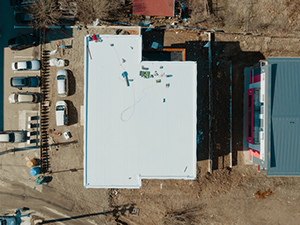
Once PVC is selected, installation should follow the written roof scope. That can include substrate preparation, insulation or cover board where required, the approved attachment method, membrane layout, heat-welded seams, and compatible flashing at rooftop penetrations, walls, curbs, edges, and other transitions.
Quality checks should also match the selected system and contract. The owner can ask how seam quality will be evaluated, how penetrations and transitions will be reviewed, which concealed conditions could change the scope, and what project documents are included at closeout. For related system-installation context, CVC also maintains a Greenwood Conklin installer page. These questions keep this article focused on membrane selection without turning it into a separate installation-process page.
Reflectivity, Exposure, and Service Life
Light-colored PVC can reduce roof-surface heat gain compared with darker materials, but that does not guarantee a particular cooling-cost reduction. Energy performance also depends on insulation, HVAC operation, occupancy, air leakage, roof size, and the rest of the building envelope.
PVC can also be useful where certain grease, oil, or chemical exposures are relevant, but product resistance varies. The specific exposure should be compared with the selected membrane manufacturer’s compatibility information rather than treated as a universal property of every PVC product.
There is also no single service-life figure that applies to every PVC roof. Longevity depends on the roof assembly, installation, drainage, exposure, traffic, maintenance, repairs, and product used. A fixed 25-to-30-year promise should not substitute for the actual system documentation and building conditions.
PVC Single-Ply Roofing in Greenwood, IN
CVC Roofing & Sheet Metal provides commercial single-ply roofing in Greenwood and elsewhere in its Indiana service area. Its single-ply roofing overview provides broader context for PVC, TPO, and EPDM options, while a Greenwood roof inspection can help document the existing condition before a system is selected.
The best PVC decision starts with the building, not the headline benefits. Confirm the substrate, drainage, attachment, insulation, rooftop activity, detailing, access, and future repair compatibility before approving the system.
Frequently Asked Questions
What does PVC single-ply mean for a commercial roof?
PVC is a thermoplastic membrane used on many low-slope roofs. Its field seams are typically joined with hot air, creating a continuous membrane when the surfaces are properly prepared and welded.
Does white PVC automatically reduce cooling costs?
No. A reflective membrane can reduce roof-surface heat gain, but actual energy performance also depends on insulation, HVAC operation, occupancy, air leakage, roof size, and other building conditions.
Is PVC a good option for roofs exposed to grease or chemicals?
It can be, depending on the specific exposure and product. The contractor should compare the building conditions with the compatibility information for the selected PVC membrane.
How long does a PVC commercial roof last?
There is no universal lifespan. Service life depends on the roof assembly, installation, drainage, exposure, traffic, maintenance, repairs, and the product used.