 Quality Services,
A commercial roof inspection in Greenwood, IN should give an owner more than a list of visible defects. The useful outcome is a documented record that shows where problems were found, what remains uncertain, which items need attention first, and what evidence supports the next maintenance, repair, or replacement decision. CVC Roofing & Sheet Metal provides commercial roofing services in Greenwood. Call (317) 557-0888 to discuss a roof inspection.
What an Inspection Report Should Give You
An inspection is most useful when the findings can be handed to a property owner, facility manager, or other decision-maker and used to plan the next scope of work. The report should distinguish observed conditions from assumptions and make clear where additional investigation may be needed.
| Report Item | What It Should Show | Why It Matters |
|---|---|---|
| Dated photographs | Clear images of defects, surrounding roof conditions, and important details at the time of inspection. | Creates a baseline for comparing later changes and supporting the recommended scope. |
| Defect locations | Where each condition occurs, referenced to roof sections, penetrations, drains, walls, or other identifiable features. | Lets maintenance or repair crews price and address the actual areas documented. |
| Moisture limitations | What moisture evidence was observed, what testing was performed if any, and what could not be confirmed. | Prevents a screening result or interior stain from being treated as proof of the full moisture extent. |
| Prioritized actions | Which items need immediate attention, which belong in a near-term plan, and which can be monitored. | Helps the owner separate urgent water-entry risks from routine maintenance. |
| Reinspection triggers | Conditions that should prompt another inspection, such as a major weather event, a recurring leak, or visible change in a monitored area. | Gives the facility team a practical reason to inspect sooner than the normal schedule when conditions change. |
How Thermal and Moisture Findings Should Be Used
If thermal imaging or another moisture-screening method is used, an anomaly should be treated as evidence to investigate, not automatic proof of saturated insulation or concealed roof failure. Surface temperature can be affected by roof construction, recent weather, sun exposure, and other conditions. When a thermal finding would change the repair or removal scope, the contractor should explain what additional confirmation is appropriate before that finding is used to set quantities or recommend replacement.
An interior stain has the same limitation. It confirms that moisture became visible inside the building, but it does not establish the exact roof entry point or how far water traveled through the assembly.
What the Roof Inspection Should Review
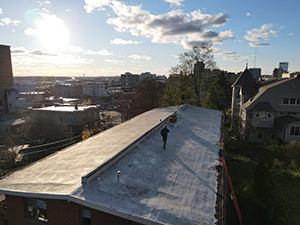
A commercial inspection should review the roof conditions that can affect current performance and future scope. Depending on the roof, that can include membrane surfaces, seams, flashing, curbs, penetrations, edges, parapets, drainage, previous repairs, rooftop equipment interfaces, visible attachment concerns, and signs of ponding or deterioration. Interior observations can also help correlate roof findings with stains or active water entry.
Building personnel can safely document interior symptoms and visible conditions from the ground, but roof access itself should be handled by trained personnel with the appropriate safety procedures.
How the Report Guides Maintenance, Repair, or Replacement
The report should connect findings to the next action instead of simply labeling the roof as good or bad. A contained seam, flashing, or membrane defect may support a targeted flat roof repair. Debris, drainage housekeeping, sealant monitoring, or other minor conditions may belong in a maintenance plan. Repeated failures, uncertain moisture extent, widespread deterioration, or supporting-material concerns can justify a broader assessment before another localized repair is approved.
If the evidence points toward a larger capital project, the owner can use the inspection report as the starting record for a scoped estimate. CVC Roofing’s flat roof replacement information for Greenwood provides context for that separate decision. The estimate should still identify which inspection findings support the proposed work and which conditions remain contingent on further investigation.
How Often Should a Commercial Roof Be Inspected?
There is no single schedule that fits every commercial roof. Inspection frequency should reflect the roof system, building use, exposure, recent repair history, manufacturer or warranty requirements when applicable, and the facility’s risk tolerance. Additional inspections may be appropriate after severe weather, after major rooftop work, when a recurring leak appears, or when a previously documented condition changes.
Owners should rely on the written requirements that apply to their actual roof rather than assume every warranty or system requires the same inspection interval.
Comprehensive Roof Inspection Services
A useful commercial roof inspection gives the owner evidence that can be carried into maintenance planning, a repair quote, or a broader replacement discussion. For a Greenwood, IN facility, that means documented locations, photographs, clear moisture limitations, prioritized actions, and practical triggers for reinspection. Call CVC Roofing & Sheet Metal at (317) 557-0888 to discuss an inspection.
Frequently Asked Questions
What should a commercial roof inspection report include?
It should document dated photos, defect locations, moisture limitations, prioritized actions, and conditions that should trigger reinspection.
Does a thermal anomaly prove that insulation is wet?
No. A thermal anomaly is a screening finding that may need confirmation before it is used to define repair, removal, or replacement scope.
How does an inspection report help with a repair estimate?
It gives the contractor documented locations and conditions to scope, while identifying uncertain areas that may require additional investigation or contingency pricing.
How often should a commercial roof be inspected?
The schedule should reflect the roof system, warranty requirements when applicable, building exposure, repair history, and major weather or condition changes rather than one universal interval.