 Quality Services,
TPO roofing is a common single-ply option for low-slope commercial buildings, but choosing it should start with the building rather than a general list of benefits. For a facility manager in Fishers, IN, the key questions involve the existing roof condition, drainage, insulation and deck conditions, rooftop equipment, project goals, and whether TPO fits the planned scope. CVC Roofing & Sheet Metal confirms TPO within its approved single-ply installation services.
Facility managers can contact CVC Roofing & Sheet Metal at (317) 557-0888 to discuss a TPO installation for a commercial property in Fishers.
What TPO Roofing Is
TPO, or thermoplastic polyolefin, is a single-ply roofing membrane used on many low-slope commercial roofs. It is installed in sheets, with seams joined as part of the roofing system. The final assembly also depends on insulation, fastening or attachment methods, flashing, penetrations, edges, and drainage details.
TPO membranes are commonly available in light colors that can have reflective properties, but energy performance should not be presented as a guaranteed building-level savings result. Interior temperatures and operating costs also depend on insulation, HVAC performance, controls, building use, climate, and other parts of the envelope.
Why TPO May Be Considered for a Commercial Building
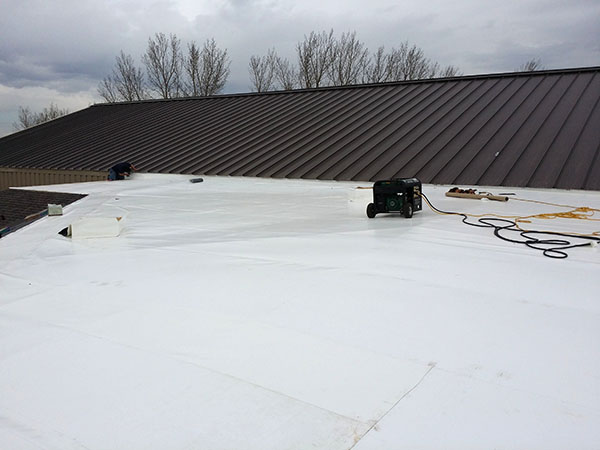
TPO can be considered when a project calls for a single-ply membrane system and the building conditions support that approach. Its suitability depends on the roof design, existing assembly, structural and drainage conditions, rooftop use, and the requirements of the proposed installation.
Rather than assuming TPO is always the lowest-cost or easiest option, property managers should compare the actual project scope. Tear-off needs, insulation, deck conditions, penetrations, edge details, access, drainage work, and other preparation can all affect the final installation.
Installation Details Matter
Long-term performance depends on more than the membrane itself. Seams, flashing, penetrations, roof edges, drains, and transitions all need to be detailed for the specific roof. Those areas should be reviewed as part of the installation scope because they connect the field of the membrane to other building components.
Before work begins, the contractor should understand the existing roof assembly and the conditions that may affect the new system. If moisture, damaged insulation, deck concerns, or drainage problems are present, those issues may need to be addressed before the installation can be finalized.
Drainage Should Be Evaluated Before Installation
Low-slope roofs depend on effective drainage, and a new membrane does not automatically correct an existing drainage problem. Ponding can involve slope, drains, scuppers, gutters, blocked outlets, settlement, or other conditions.
A facility manager should ask how the existing drainage layout will work with the proposed TPO system and whether any drainage corrections are included in the project. That helps separate membrane selection from other roof conditions that may need their own solution.
Rooftop Equipment and Access Affect the Design
HVAC units, vents, curbs, pipes, and other rooftop equipment create penetrations and transitions that must be incorporated into the roofing plan. Service traffic around that equipment can also affect how certain roof areas are used over time.
The project should account for those conditions without assuming one protection method is required for every roof. Access patterns, equipment locations, and the final roof design should guide any project-specific protection or detailing recommendations.
Maintenance Expectations for a TPO Roof
TPO roofing should not be treated as maintenance-free. Seams, flashing, drains, penetrations, edges, and areas near rooftop equipment can be included in appropriate roof inspections and maintenance planning.
There is no single inspection frequency that fits every TPO roof. Timing should reflect the building, roof age, exposure, project documentation, observed conditions, significant weather events, and any written maintenance or warranty requirements that apply to the installed system.
Can TPO Be Installed Over an Existing Roof?
In some projects, a new single-ply system may be installed as part of a recover or overlay approach, while other projects require removal of existing roofing materials. Whether that is appropriate depends on the existing assembly, moisture conditions, deck and insulation condition, code and project requirements, and the proposed roofing system.
A facility manager should not assume that an existing roof can simply be covered. The current conditions and project requirements need to be evaluated before the installation method is selected.
Is TPO the Right Choice for Your Fishers Building?
TPO can be a strong candidate for some low-slope commercial buildings, but it should be compared with the actual needs of the property. Existing roof condition, drainage, insulation, deck condition, rooftop equipment, project scope, and budget all influence the decision.
CVC Roofing & Sheet Metal’s confirmed commercial scope includes single-ply installation for TPO, PVC, and EPDM, along with general commercial roofing and other approved commercial services. The company also brings more than 45 years of combined industry experience. The best system choice should come from the specific building and project rather than a one-size-fits-all recommendation.
TPO Roofing in Fishers, IN
CVC Roofing & Sheet Metal serves Fishers within its confirmed Indiana service area. Facility managers planning a TPO installation can use the project review to clarify roof condition, drainage, insulation, penetrations, access, and other factors before finalizing the scope.
To discuss TPO roofing for a commercial building in Fishers, contact CVC Roofing & Sheet Metal at (317) 557-0888.
Frequently Asked Questions
How long does a TPO roof last?
There is no universal lifespan for every TPO roof. Installation quality, exposure, maintenance, drainage, rooftop activity, and the overall roof assembly can all affect service life.
Is TPO roofing less expensive than other commercial roof systems?
Not always. Final cost depends on the roof size, preparation, insulation, deck condition, access, drainage work, and the complete installation scope.
Can TPO roofing be installed over an existing roof?
Sometimes, but only when the existing roof conditions and project requirements support that approach. Moisture, deck condition, insulation, code requirements, and the proposed system all need to be considered.
What maintenance does a TPO roof need?
Maintenance should reflect the roof’s actual condition and project documentation. Seams, flashing, drains, penetrations, edges, and rooftop equipment areas can all be included in appropriate inspections.