 Quality Services,
Two buildings can get the same TPO membrane from the same manufacturer and end up with roofs that perform very differently. The variable is how the membrane was attached to the building. TPO roof installation comes in three methods, and choosing between them is a decision Indianapolis building owners make once and live with for decades. At CVC Roofing & Sheet Metal we walk owners through that choice before anything gets ordered.
Call CVC Roofing & Sheet Metal at (317) 557-0888 for TPO roof installation in Indianapolis, IN.
Fastened vs. Adhered vs. Ballasted TPO Roof Installation
All three methods put the same membrane on the roof. What differs is what holds it there, and each answer brings its own performance profile.
Mechanical fastening uses screws and plates driven through the insulation into the deck. Adhesion bonds the membrane to the insulation across the entire surface. Ballasting lays the membrane loose under stone. The right choice follows from the deck, the wind exposure, the load capacity, and the schedule.
Mechanically Fastened Systems on Steel Decks
Fasteners and plates go through the membrane and insulation into the structural deck, and the next sheet laps over the fastener row and gets welded down, so nothing stays exposed.
This method suits open steel decks, which describes a large share of the logistics and distribution buildings around Indianapolis. It installs quickly, works in a wider range of weather than adhesives do, and carries a lower installed cost than an adhered system.
The trade-offs are real. Every fastener is a small thermal bridge, so the assembly effective R-value comes in below its rated value. Under wind uplift the membrane between fastener rows flutters, and that repeated flexing works the seams over time. On a tall or exposed building, fastener patterns tighten considerably to handle it.
Fully Adhered TPO Roof Installations Against Wind Uplift
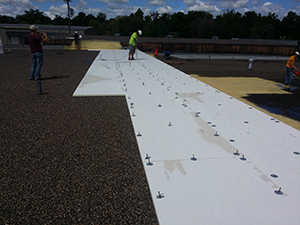
Adhesive bonds the membrane to the insulation across the full surface, so membrane and substrate move together and there is no flutter to manage.
Concrete and wood decks favor this method, because fasteners in those materials are less straightforward than in steel. Buildings in high-wind exposure, like the flat-roofed structures near the airport and the interstate exchanges, benefit from uplift performance that does not rely on discrete attachment points. Where insulation performance matters, no fasteners bridge the thermal layer.
It costs more installed. Surface preparation has to be thorough, since adhesive over a dusty or damp substrate will not bond. Adhesives also have minimum application temperatures and real cure times, which shortens the Indianapolis installation season on both ends of the year.
Ballasted TPO Roof Installation
The membrane is laid loose over the insulation and held in place by a layer of stone spread across it.
It goes down fast, it avoids penetrating the membrane at all, and it can work well over an existing system during a re-roof. The stone also shields the membrane from UV, which slows aging.
The limits are structural. Ballast adds meaningful weight, and the building has to have been designed for it or verified by an engineer. Leaks are harder to find under stone, and inspection means moving ballast. It appears mostly on existing buildings that already carry it rather than on new Indianapolis construction.
Deck type, wind exposure, insulation goals, and schedule should drive this decision. A steel-deck warehouse with a tight timeline and a concrete-deck medical building on an exposed site will not reach the same answer, and neither one is wrong.
Getting the TPO Roof Installation Method Right
There is no ranking here. Each method is correct on some buildings and wrong on others, and the honest version of this conversation starts with your deck and your exposure rather than with a preferred system. Sorting that out before the order is placed is what lets a TPO roof perform for its full service life.
For TPO roof installation in Indianapolis, IN, contact CVC Roofing & Sheet Metal at (317) 557-0888 today.
FAQ
Can the installation method be changed during a re-roof?
Often yes, though switching to ballast requires a structural review and switching to adhered requires a substrate that will accept adhesive.
Does the attachment method affect the manufacturer warranty?
Yes. Warranty terms and required wind ratings are tied to the assembly as installed, so the method has to be specified up front.
How much does weather delay a TPO installation in Indianapolis?
Mechanically fastened work continues through a wider temperature range, while adhered systems need surfaces above the adhesive minimum temperature and a dry cure window.