 Quality Services,
Commercial roof replacement should begin with evidence that replacement is the right scope for the building. For an Indianapolis, IN property, that means confirming whether defects are still localized enough to repair, whether a recover system is practical, what hidden deck or insulation work may be needed, and how the project will protect an occupied building. CVC Roofing & Sheet Metal provides commercial roof replacement services in Indianapolis. Call (317) 557-0888 to discuss the roof.
Confirm Whether Repair Is Still Practical
Replacement should not be triggered by roof age or one leak alone. Start with a documented commercial roof inspection in Indianapolis that looks at membrane condition, seams, flashing, penetrations, drainage, repair history, insulation concerns, and deck condition where evidence is available.
Localized defects can still support repair when the surrounding assembly remains serviceable. Replacement becomes more reasonable when deterioration is widespread, moisture or deck damage extends across multiple areas, repeated repairs no longer provide dependable service, or the existing assembly cannot support the building’s long-term needs.
Compare Tear-Off and Recover Suitability
| Factor | Tear-Off Replacement | Recover System |
|---|---|---|
| Existing roof condition | Useful when wet, deteriorated, or incompatible materials must be removed | Requires an existing assembly that is suitable to remain in place |
| Moisture | Allows damaged insulation and concealed wet areas to be removed as they are found | Should not trap unresolved moisture below the new system |
| Deck and structure | Provides direct access to inspect and repair the deck during tear-off | Requires confirmation that the existing assembly and added load are acceptable |
| Code and warranty requirements | Can simplify compliance when removal is required by the project conditions | Eligibility depends on applicable code, manufacturer requirements, and the existing roof |
| Disruption and staging | Usually involves more removal, debris handling, and weather exposure planning | Can reduce tear-off activity when the roof qualifies, but still requires careful preparation |
The contractor should explain why one approach fits the building rather than treating recover as the automatic lower-cost option or tear-off as the only professional choice.
Plan for Deck and Insulation Allowances
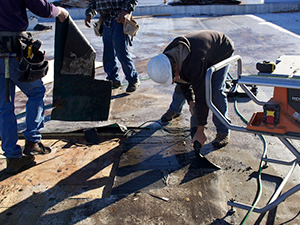
Some conditions cannot be confirmed until existing roofing materials are removed. Deteriorated decking, wet insulation, corroded fasteners, or concealed damage may become visible only during tear-off.
The proposal should state how these conditions will be documented, who approves additional work, and how pricing will be handled. Unit prices, allowances, or another agreed change-order method can make hidden-condition work more predictable without pretending the entire scope is known before the roof is opened.
Correct Drainage and Flashing Problems
A replacement project should address the reasons an old roof failed, not simply install a new membrane over the same weak points. The scope should explain how drains, scuppers, low areas, tapered insulation, parapets, curbs, penetrations, and perimeter details will be handled.
If ponding is caused by blocked drainage, damaged insulation, or roof geometry, the contractor should identify which correction is included. Flashing should also be rebuilt or replaced where needed rather than automatically copied from a detail that has already failed.
Sequence Work Around an Occupied Building
Commercial roof replacement often happens while the building remains in use. The project plan should identify roof access, staging, parking or loading restrictions, debris removal, interior protection, rooftop equipment coordination, and communication with building staff.
Weather planning matters as well. The crew should limit how much roof is opened at one time, maintain temporary protection when conditions change, and avoid leaving exposed areas beyond what can be made watertight. CVC’s commercial roofing services in Indianapolis provide related context on coordinating inspections, repairs, maintenance, and replacement around an occupied property.
Define Closeout Before Work Starts
Owners should know what evidence will be provided when the project is complete. Closeout may include final inspection findings, photographs, approved change orders, material information, warranty documents or registration where applicable, and confirmation that drainage, flashing, penetrations, seams, and edge details match the written scope.
A clear closeout process also gives the owner a starting record for future maintenance. After replacement, commercial roof maintenance in Indianapolis can help track drainage, flashing, seams, rooftop traffic areas, and other conditions over time.
Commercial Roof Replacement in Indianapolis, IN
A sound replacement decision connects condition evidence to the proposed scope. Owners should understand why repair is no longer practical, whether tear-off or recover is appropriate, how hidden deck and insulation conditions will be handled, how drainage and flashing will be corrected, and how occupied-building disruption will be controlled. Call CVC Roofing & Sheet Metal at (317) 557-0888 to discuss an Indianapolis commercial roof replacement.
Frequently Asked Questions
How do I know if my commercial roof needs replacement instead of repair?
Replacement is more likely when deterioration, moisture, deck damage, or recurring failures are widespread rather than localized. The decision should follow a documented inspection.
When can a commercial roof be recovered instead of torn off?
A recover may be possible when the existing assembly is dry, stable, compatible, and acceptable under applicable code and warranty requirements. Suitability must be confirmed for the specific building.
How should hidden deck or insulation damage be handled?
The proposal should define how hidden conditions will be documented, approved, and priced before additional work is performed.
How can replacement work minimize disruption to an occupied building?
Use phased work areas, planned access and staging, weather contingencies, debris controls, rooftop-equipment coordination, and a clear communication plan for building staff.