
 Quality Services,
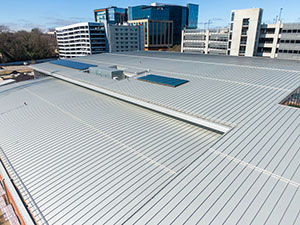
For commercial building owners in Indianapolis IN, a flat roof protects inventory, equipment and daily operations. When a leak or visible defect appears, the first question is whether it is a localized problem that a repair can fix or a sign of damage that needs a broader assessment. This article explains how to tell the difference, what limits a spot repair and what a useful repair quote should include.
For professional guidance, CVC Roofing can be reached at 317-557-0888 to discuss flat roof repair for a commercial property in Indianapolis IN.
Flat Roof Repair: Localized Defect or Broader Problem?
Flat roofs rely on drainage, intact seams and sound flashing to protect a building. When a defect develops, water can enter the roof assembly and travel beyond the opening. Water that enters at a small opening may spread through the insulation and appear inside the building away from the entry point. The visible symptom and the actual cause therefore need separate investigation.
An inspector looks at specific evidence before recommending a scope. The table below connects common symptoms to the evidence that matters and what each can indicate.
| Symptom | Inspection Evidence to Look For | What It May Indicate |
|---|---|---|
| Seam separation or lifting | Open or lifted seam edges, gaps, dirt or debris trapped in the seam, repeated problems along the same line | Often a localized repair when the surrounding membrane is sound; a pattern of failing seams points to a broader issue |
| Penetration flashing | Cracked sealant, loose collars or boots, gaps around pipes, vents and rooftop unit curbs | Usually repairable by itself, but nearby wet insulation still has to be ruled out |
| Wall, curb and edge flashing | Pulled-away terminations, loose metal edge, open laps, damaged counterflashing | Repairable when the metal and substrate are sound; widespread movement suggests a wider scope |
| Punctures, blisters or splits | Cut or torn membrane, raised blisters, cracking at the surface | A single puncture is typically local; multiple blisters or brittle membrane need a closer look |
| Ponding water | Standing water that remains well after rain, staining or algae at low spots, drains with debris | Cleaning a drain can help, but persistent ponding may involve slope or deck conditions |
| Interior ceiling stain | Stain location compared with the roof layout, repeat staining, active drips after rain | A stain alone does not show where the water entered or how far it spread |
| Moisture extent | Wet or compressed insulation found by a moisture survey or test cuts, not by surface appearance | The result decides between a local repair and a larger section or system scope |
When a Localized Repair Makes Sense
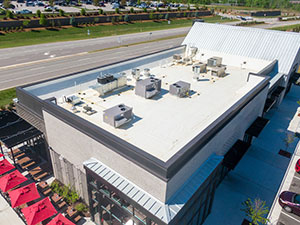
A spot repair may be appropriate when the defect is isolated, the surrounding membrane is sound and well bonded, and the affected insulation is dry. The patch or flashing repair also has to be compatible with the existing membrane, since materials such as EPDM, TPO and modified bitumen are not repaired the same way. For material-specific guidance, see TPO roof repair in Indianapolis and EPDM roof repair in Indianapolis.
There are limits. Repeated leaks in the same area, widespread blistering, brittle or shrinking membrane, many failing seams or saturated insulation suggest that patching will only delay the problem. In those cases a larger section repair or a different plan may be a better use of budget.
When Further Assessment Is Needed
An interior ceiling stain alone cannot establish the source or extent of hidden roof damage. Staining may be old, may come from a condensation or mechanical source, or may sit well away from the point of entry. When moisture could be spread through the roof system, a more thorough commercial roof inspection in Indianapolis can document the condition of the membrane, flashings, drains and insulation before money is spent on repairs.
Further assessment is also appropriate when there are several leaks, when leaks return after earlier repairs, or when the roof is near the end of its service life. If an assessment shows widespread damage, the conversation may move to flat roof replacement in Indianapolis. Owners should not walk the roof to investigate. Access should be left to trained crews who can work safely and document what they find.
What a Flat Roof Repair Quote Should Include
A clear quote makes it easier to compare options and avoids surprises once work begins. Look for:
- The locations and type of each defect being repaired, with photos where possible.
- The membrane type and the repair materials to be used.
- Flashing, sealant, seam and drain work included in the scope.
- How roof access, equipment staging and tenant or customer notification will be handled.
- How weather delays and hidden damage found during the work will be addressed.
- Any written warranty on the repair work and what it covers.
Access planning matters on occupied buildings. Rooftop units, hatches, ladders and shared parking areas all affect how a crew can work, and scheduling repairs for a low-activity period can reduce disruption.
The Cost of Waiting on Flat Roof Repair
Delay often makes a repair more complicated. Water that stays in the roof assembly can wet insulation, stress the deck and reduce thermal performance, which may raise heating and cooling costs. In colder months, trapped moisture can freeze and expand, which can widen cracks and stress seams. Water can also damage ceilings, electrical systems and equipment, and wet floors create slip hazards. Early action keeps options open, allows repairs to be planned and creates a clearer record of roof condition for budgeting and insurance conversations.
Flat Roof Repair Experts in Indianapolis, IN
Some flat-roof problems produce warning signs before damage becomes extensive. Ponding water, surface cracks, loose flashing and interior staining are common early signs. Working with experienced professionals helps ensure problems are identified accurately and addressed in proportion to what the roof actually needs. If your roof is showing signs of distress, CVC Roofing is available to discuss repair options for your building. Call 317-557-0888 to talk through the next step for your property in Indianapolis IN.
Frequently Asked Questions
What happens if water gets trapped under a flat roof membrane?
Trapped water can spread through the insulation and, over time, damage the deck and weaken the roof system.
Can delayed flat roof repair lead to full roof replacement?
It can. Unresolved leaks may spread into wet insulation and a wider area, and in some cases replacement becomes the more practical option.
Are interior leaks always visible right away?
No. Water can travel within the roof system before it shows up inside, and a stain may be some distance from the actual opening.
Can a flat roof leak always be fixed with a spot repair?
Not always. A spot repair suits an isolated defect on sound, dry material, while repeated leaks or wet insulation usually call for a broader assessment first.