
 Quality Services,
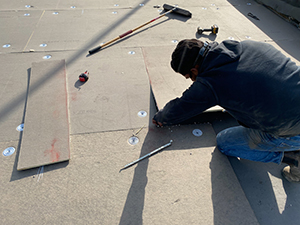
TPO roof repair starts with a decision: is the problem a localized defect, such as an open seam, a puncture or failed flashing, or is it a sign of wider membrane or moisture damage that needs a broader assessment? Getting that answer right shapes the scope, the budget and the schedule. This article explains how TPO repairs are evaluated, what limits a spot repair and what a useful quote should cover.
CVC Roofing performs TPO roof repair for commercial properties in Indianapolis, IN. Call (317) 557-0888 to discuss roofing concerns and request an estimate.
TPO Roof Repair: Localized Defect or Broader Problem?
TPO is a common single-ply membrane on commercial low-slope roofs, and CVC Roofing lists it among its primary single-ply systems. A TPO roof can still develop problems from weather exposure, rooftop traffic, aging seams and movement around penetrations or equipment. Water that enters at one point can travel beneath the membrane and appear inside the building far from the source, so the visible symptom and the cause are often in different places.
The table below connects common TPO symptoms to the inspection evidence that matters and what each can indicate.
| Symptom | Inspection Evidence to Look For | What It May Indicate |
|---|---|---|
| Open or lifted heat-welded seam | Visible gap or lifted edge along a seam, a probe check by the inspector, dirt or debris along the seam line | Often a localized rewelding job when the surrounding membrane is sound; seams failing along many lines point to a broader issue |
| Puncture or tear | Cut, gouge or tear in the membrane, nearby rooftop traffic paths, equipment access points | A single puncture is typically local; clusters near service routes may call for walkway protection as well |
| Penetration flashing | Cracked sealant, loose boots or collars at pipes, vents and conduit, gaps at curbs | Usually repairable on its own, but nearby insulation still has to be checked for moisture |
| Wall and edge flashing | Pulled-away terminations, loose metal edge, open laps, membrane tension at corners | Repairable when the metal and substrate are sound; widespread pulling may reflect shrinkage or movement |
| Membrane shrinkage or surface wear | Tight membrane at edges and corners, exposed reinforcement, crazing or heavy surface wear | Condition across the roof matters more than any one spot, which may point to a broader assessment |
| Ponding water | Standing water well after rain, dirt rings at low spots, partly blocked drains | Clearing a drain can help, but persistent ponding may involve slope or deck conditions |
| Interior stain or moisture extent | Stain location compared with the roof layout, wet or compressed insulation found by a moisture survey or test cuts | A stain alone does not show the point of entry or how far moisture has spread |
How TPO Repairs Are Made
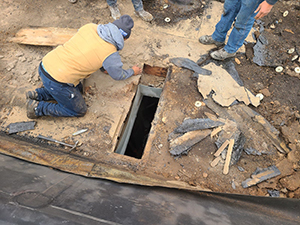
TPO roof repair requires more than a surface patch. Single-ply systems need repair methods that match the membrane, the seam construction and the flashing details. TPO seams are typically heat welded, and a lasting patch or seam repair generally depends on the surface being clean and dry and on the repair material being compatible with the existing membrane. Aged or dirty membrane may need cleaning or preparation before a weld will bond well, and flashing repairs often involve sealants or termination hardware as well as membrane work.
For other single-ply systems, see EPDM roof repair in Indianapolis, and for repair decisions on other low-slope roofs, flat roof repair in Indianapolis.
Limits of a Localized TPO Repair
A spot repair is reasonable when the defect is isolated, the membrane around it is flexible and well bonded, and the insulation below is dry. It is less likely to hold when leaks repeat in the same area, when seams are opening along many lines, when the membrane is brittle or shrinking at edges and corners, or when insulation is wet. In those cases a larger section repair or a broader plan may be a better use of budget, and the owner may need to weigh TPO roofing in Indianapolis options.
What a TPO Repair Method Should Address
On a mechanically attached TPO roof, the crew should consider the membrane around plates and fastener rows if the defect sits near an attachment point. On a fully adhered roof, loss of bond and substrate condition may change the repair area. At a curb or roof edge, the work may involve separate flashing pieces, termination bars or other approved details rather than a single patch across the visible opening. The proposal should identify the existing attachment approach and describe repairs consistent with the specific membrane system.
If the roof has been patched previously, ask whether the old patch is stable enough to remain and whether the new material can be welded to the aged surface. Contractors may need to clean and test a sample area before relying on a weld. If a test does not demonstrate a suitable bond, the repair scope should change rather than simply adding more patch material.
Quote Inclusions and Access Planning
A clear quote should name the location and type of each defect, the repair method and materials, the flashing, sealant and seam work in scope, and how hidden damage found during the work will be handled. It should also say whether any repair warranty is offered and what it covers. Access planning matters on occupied buildings: rooftop units, hatches, ladders, shared parking and tenant notification all affect how a crew can work, and scheduling during a low-activity period can reduce disruption. Owners should leave roof access to trained crews rather than walking the roof themselves.
Checking and Documenting the Finished Repair
Ask for a closeout record showing the repaired locations, materials used and before-and-after photographs. The contractor should inspect seams and flashing transitions according to the selected repair method and document any separate drainage or moisture conditions that remain unresolved. Keep this record with earlier inspection findings so a future service crew can distinguish a new defect from work already completed.
When Further Assessment Is Needed
A ceiling stain alone should not be used to diagnose hidden damage. It may be old, may come from another source or may sit well away from the point of entry. A more thorough commercial roof inspection in Indianapolis can document the membrane, seams, flashings, drains and insulation before money is spent. Further assessment is also appropriate when there are several leaks, when leaks return after earlier repairs or when the roof is near the end of its service life. If the findings show widespread damage, the discussion may move to flat roof replacement in Indianapolis.
TPO Roof Repair Services in Indianapolis, IN
Prompt repair can limit how far water spreads into insulation and deck materials, which helps protect inventory, equipment and daily operations. A damaged membrane can also affect the roof’s reflective performance, so restoring weak points supports the roof’s intended function. CVC Roofing works with single-ply commercial roofing systems. The repair decision should reflect documented defects, compatible materials and the condition of the surrounding assembly.
CVC Roofing provides TPO roof repair for commercial properties in Indianapolis, IN. Call (317) 557-0888 to schedule an estimate for your commercial roof.
Frequently Asked Questions
What causes a TPO roof to need repair?
Common causes include seam separation, punctures, storm exposure, rooftop traffic, flashing wear and drainage issues that allow water to stress the membrane.
Can TPO roof repair help avoid full replacement?
Sometimes. If the damage is limited and the roof is otherwise in workable condition, repairs can extend roof life, but widespread damage or wet insulation may call for a larger scope.
Does a ceiling stain mean the TPO membrane is damaged?
Not necessarily. A stain shows that water reached the ceiling, not where it entered or how far it spread, so the roof needs to be inspected before a repair scope is set.
Is TPO roofing commonly used on commercial buildings?
Yes. TPO is a widely used single-ply membrane on commercial low-slope roofs, and CVC Roofing identifies it as one of the single-ply systems it works with.